Kinematics Simulator
무료
0.0.9for iPhone, iPad and more
Age Rating
Kinematics Simulator 스크린 샷
About Kinematics Simulator
About
an open source physics at Singapore simulation based on codes written by Félix Jesús Garcia Clemente, Francisco Esquembre and Loo Kang Wee.
more simulation are available on Support URL
Introduction
Topics
Kinematics
Speed, velocity and acceleration
Graphical analysis of motion
Description
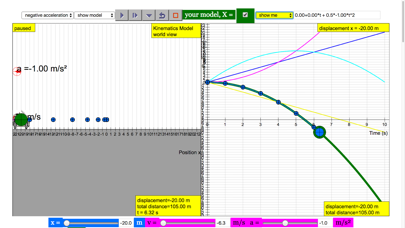
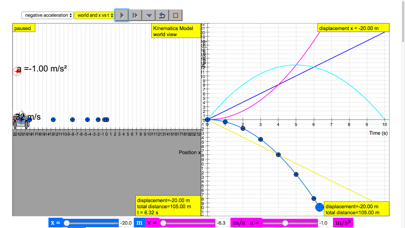
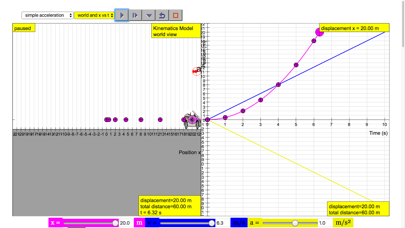
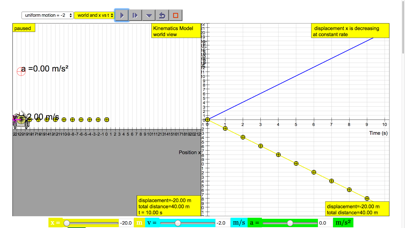
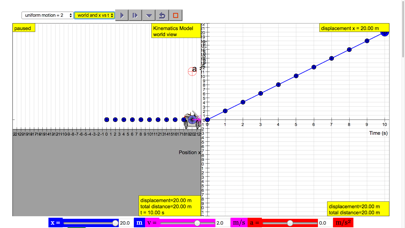
This simulation has a drop-down menu for exploration of
(i) at rest use of progressive mathematical model is encouraged X = 0 for example
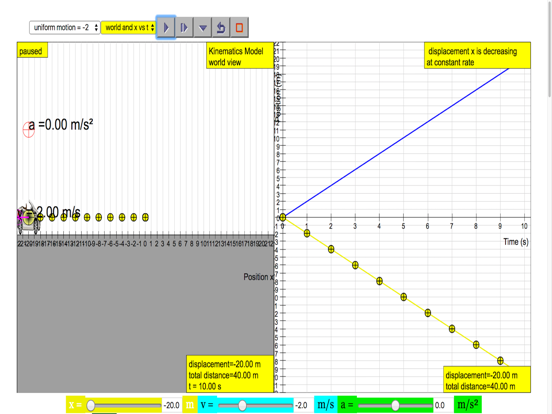
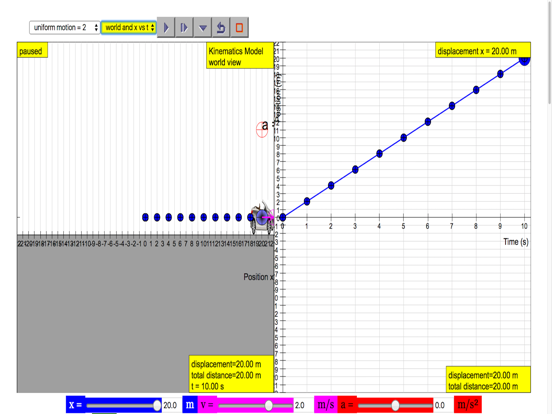
(ii) moving with uniform velocity, use of progressive mathematical model is encouraged for example X = 1*t for a constant velocity motion of v =1 m/s
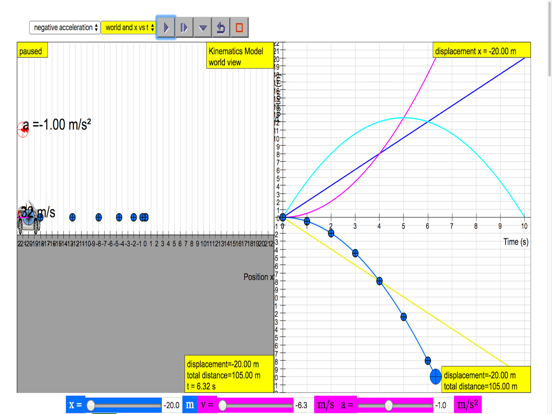
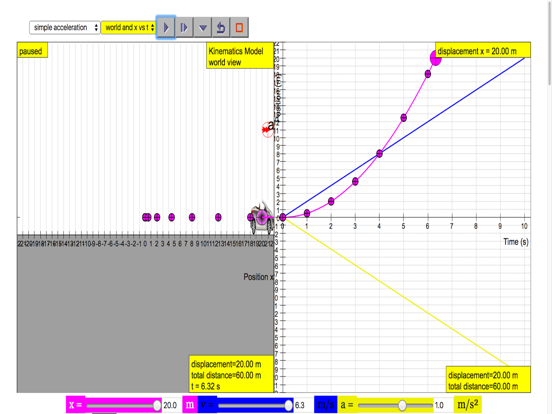
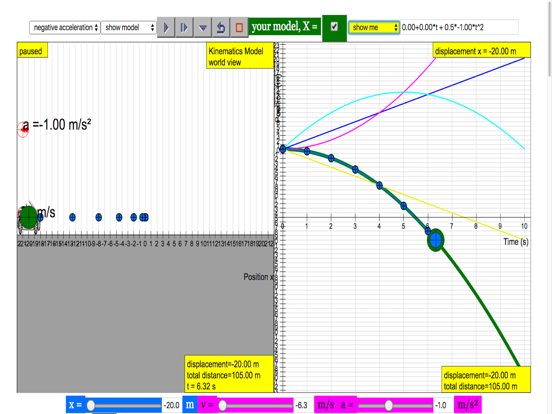
(iii) moving with non-uniform velocity (eg, constant acceleration) use of progressive mathematical model is encouraged for example X = 0.5*1*t^2 for a constant acceleration motion of a =1 m/s^2
When only the velocity-time graph check-box is selected, it can be explored for the following cases too.
(i) at rest ,
(ii) moving with uniform velocity (eg, no acceleration)
(iii) moving with uniform acceleration (eg, constant acceleration = 9.81 m/s^2)
(iv) moving with non-uniform acceleration
Sample Learning Goals
(e) plot and interpret a displacement-time graph and a velocity-time graph
(f) deduce from the shape of a displacement-time graph when a body is:
(i) at rest example of progressive mathematical model is encouraged X = 0
(ii) moving with uniform velocity example of progressive mathematical model is encouraged X = 1*tf or a constant velocity motion of v =1 m/s
(iii) moving with non-uniform velocity example of X = 0.5*1*t^2 for a constant acceleration motion of a =1 m/s^2
(g) deduce from the shape of a velocity-time graph when a body is:
(i) at rest
(ii) moving with uniform velocity
(iii) moving with uniform acceleration
(iv) moving with non-uniform acceleration
Interesting Fact 1
Mystery could take the form of to describe it in an equation, called model.
Give the challenge to solve the mystery of a predictive equation that can be use to tell the future, more precisely the movement of a car, in a physics lesson.
Through the model selected by the students, it gives an indication of the students prior knowledge about what they know now, so that the teacher can understand the gaps of understanding for personalised mentoring
Interesting Fact 2
This app is produce real numbers to coincident with the real world data of gravity pull at 9.81 m/s^2 with some random errors simulating real data-logger results. There is a mathematical modelling pedagogy built into the simulation for students to make effort to represent the physics similar to Tracker's particle modeling.
Acknowledgement
My sincere gratitude for the tireless contributions of Francisco Esquembre, Fu-Kwun Hwang, Wolfgang Christian, Félix Jesús Garcia Clemente, Anne Cox, Andrew Duffy, Todd Timberlake and many more in the Open Source Physics community. I have designed much of the above based on their ideas and insights, and I thank the OSP community for which Singapore was honored with 2015-6 UNESCO King Hamad Bin Isa Al-Khalifa Prize for the Use of ICTs in Education.

an open source physics at Singapore simulation based on codes written by Félix Jesús Garcia Clemente, Francisco Esquembre and Loo Kang Wee.
more simulation are available on Support URL
Introduction
Topics
Kinematics
Speed, velocity and acceleration
Graphical analysis of motion
Description
This simulation has a drop-down menu for exploration of
(i) at rest use of progressive mathematical model is encouraged X = 0 for example
(ii) moving with uniform velocity, use of progressive mathematical model is encouraged for example X = 1*t for a constant velocity motion of v =1 m/s
(iii) moving with non-uniform velocity (eg, constant acceleration) use of progressive mathematical model is encouraged for example X = 0.5*1*t^2 for a constant acceleration motion of a =1 m/s^2
When only the velocity-time graph check-box is selected, it can be explored for the following cases too.
(i) at rest ,
(ii) moving with uniform velocity (eg, no acceleration)
(iii) moving with uniform acceleration (eg, constant acceleration = 9.81 m/s^2)
(iv) moving with non-uniform acceleration
Sample Learning Goals
(e) plot and interpret a displacement-time graph and a velocity-time graph
(f) deduce from the shape of a displacement-time graph when a body is:
(i) at rest example of progressive mathematical model is encouraged X = 0
(ii) moving with uniform velocity example of progressive mathematical model is encouraged X = 1*tf or a constant velocity motion of v =1 m/s
(iii) moving with non-uniform velocity example of X = 0.5*1*t^2 for a constant acceleration motion of a =1 m/s^2
(g) deduce from the shape of a velocity-time graph when a body is:
(i) at rest
(ii) moving with uniform velocity
(iii) moving with uniform acceleration
(iv) moving with non-uniform acceleration
Interesting Fact 1
Mystery could take the form of to describe it in an equation, called model.
Give the challenge to solve the mystery of a predictive equation that can be use to tell the future, more precisely the movement of a car, in a physics lesson.
Through the model selected by the students, it gives an indication of the students prior knowledge about what they know now, so that the teacher can understand the gaps of understanding for personalised mentoring
Interesting Fact 2
This app is produce real numbers to coincident with the real world data of gravity pull at 9.81 m/s^2 with some random errors simulating real data-logger results. There is a mathematical modelling pedagogy built into the simulation for students to make effort to represent the physics similar to Tracker's particle modeling.
Acknowledgement
My sincere gratitude for the tireless contributions of Francisco Esquembre, Fu-Kwun Hwang, Wolfgang Christian, Félix Jesús Garcia Clemente, Anne Cox, Andrew Duffy, Todd Timberlake and many more in the Open Source Physics community. I have designed much of the above based on their ideas and insights, and I thank the OSP community for which Singapore was honored with 2015-6 UNESCO King Hamad Bin Isa Al-Khalifa Prize for the Use of ICTs in Education.
Show More
최신 버전 0.0.9의 새로운 기능
Last updated on Jun 20, 2017
오래된 버전
This app has been updated by Apple to display the Apple Watch app icon.
better zooming and drag features
Show More
Version History
0.0.9
Jun 20, 2017
This app has been updated by Apple to display the Apple Watch app icon.
better zooming and drag features
0.0.8
Jun 6, 2017
bug fix
0.0.5
Mar 10, 2017
v5
added maximum range = 80 instead of 20
motion diagram goes up a slight notch to help visualization of motion that reverse
v4
minor enhancements
added MCQ responses and feedback
v3
minor enhancements
kinematics modeling correct when for conceptest 6 3
v2
added new features such as concept test questions playback.
better graphics
2 cars
added maximum range = 80 instead of 20
motion diagram goes up a slight notch to help visualization of motion that reverse
v4
minor enhancements
added MCQ responses and feedback
v3
minor enhancements
kinematics modeling correct when for conceptest 6 3
v2
added new features such as concept test questions playback.
better graphics
2 cars
0.0.3
Mar 6, 2017
v3
minor enhancements
kinematics modeling correct when for conceptest 6 3
v2
added new features such as concept test questions playback.
better graphics
2 cars
minor enhancements
kinematics modeling correct when for conceptest 6 3
v2
added new features such as concept test questions playback.
better graphics
2 cars
0.0.2
Mar 1, 2017
added new features such as concept test questions playback.
better graphics
2 cars
better graphics
2 cars
1.0
Jan 2, 2017
Kinematics Simulator FAQ
제한된 국가 또는 지역에서 Kinematics Simulator를 다운로드하는 방법을 알아보려면 여기를 클릭하십시오.
Kinematics Simulator의 최소 요구 사항을 보려면 다음 목록을 확인하십시오.
iPhone
iOS 8.0 이상 필요.
iPad
iPadOS 8.0 이상 필요.
iPod touch
iOS 8.0 이상 필요.
Kinematics Simulator은 다음 언어를 지원합니다. 영어